Exposição Um Corpo no Espaço
Anna Bella Geiger: A Bodyin space
Anna Bella Geiger is a pioneering artist: throughout her career, which spans more than seven decades of creativity, she has promoted a profound discussion on the idea of space, in its physical and poetic, real and symbolic dimensions. For Geiger, representations are not neutral: as we see in Typus Terra Incognita, commissioned by Projeto Maravilha, maps and archives are devices of power. At the same time, the artist has resorted to the appearance of her own body in different media. This procedure is not imposed in an autobiographical manner, but as a method of conceptual and formal investigation—alluding not only to Anna Bella Geiger herself, but to her position as an artist, citizen, subject: a situated body, a body in space.
She is a female presence, acting in a field still rigidly marked by gender hierarchies, that enters the scene: not as a figure subject to the dominant narrative, but as an agent capable of reorganizing ways of seeing. Bridging distances, denouncing absurdities, shifting meanings, emphasizing repetitions. To expand the idea of space, we selected two projects: Situações Limite (Limit Situations) — where we see the Sugarloaf Mountain itself depicted, with the poetic reminder that “Imagination is an act of freedom” — and “Rio de Janeiro como centro cultural do mundo” (Rio de Janeiro as the cultural center of the world) in which the artist reorganizes our imagination by taking South America, Brazil, and Rio de Janeiro as the axis — still in the 1970s, long before discussions about globalization and the global South imposed themselves on the international debate.
Eight images act as indexes of the debates carried out by the artist: her body appears and reappears in close to human scale panels, deliberately presented against Rio’s landscape — in the open air, here we can relinquish the museum’s protective walls. Although we have chosen to discuss the context of these images, our intention here is to operate according to the artist’s ethics: beyond representation and explanation, to trust in the power of provocation that the artistic experience carries with it. Anna Bella Geiger: A Body in Space seeks to highlight the innovative nature of the research that the artist has been conducting since the 1950s, as one of the leading figures in international conceptual art and a defining force in Brazilian art.
Ulisses Carrilho – Curator
Maravilha Project
Alien
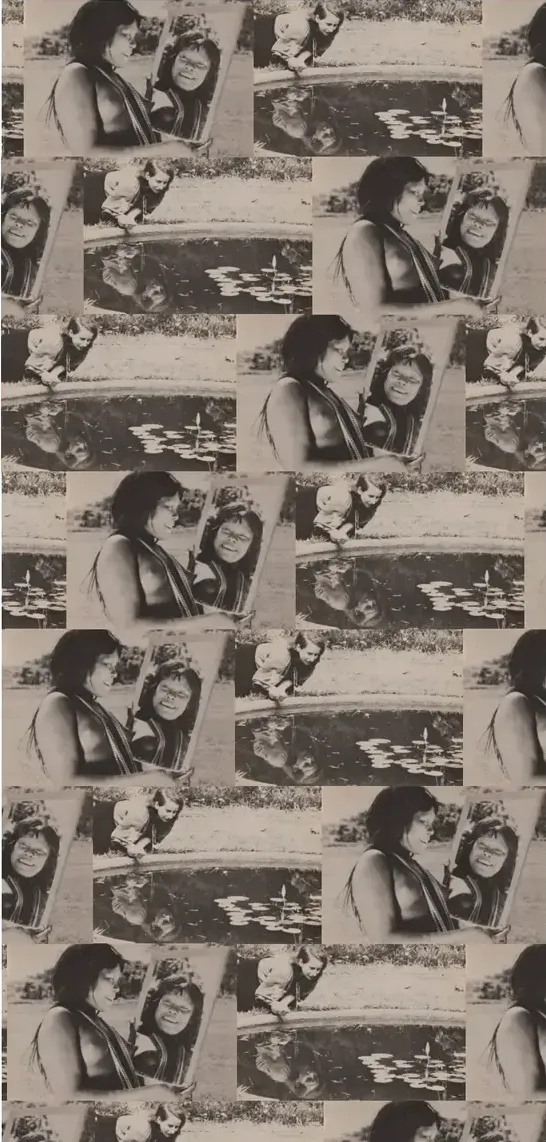
Brasil nativo/Brasil alienígena, 1976-77
[18 postcards]
Native Brazil/Alien Brazil consists of nine pairs of postcards. Each postcard depicting Indigenous Brazilians in everyday actions is paired with a second: in these, the artist restages the scene using her own body, her daughters and friends, and her domestic space. In doing so, she calls forth a feminist and anti-racist ethics of looking: the point is not to represent “a” body, but to complicate the material and symbolic conditions through which that body occupies space. Her presence before the camera is always a negotiation between exposure and refusal: she appears, but never as a passive object; instead, she asserts herself as someone who controls the way she appears. In this movement, the body becomes a conceptual tool—a surface on which tensions are tested between the intimate and the public, between what can be seen and what resists capture.
Posing with a bow and arrow, the artist exposes otherness as a central political category. By staging a “native” body that is, at the same time, “alien,” Geiger destabilizes colonial stereotypes about Brazilian identity. The image underscores the artifice of anthropological representation and the symbolic violence involved in reducing a territory to folkloric signs. The work shifts the gaze: it is not about the “other” as exoticism, but about the artist revealing how that “other” is constructed. And she considers everyone in the scene as lumpen—second-class citizens, without the right to vote.
Glossary
Anna Bella Geiger opens, within Brazilian art, a field of experimentation in which the map ceases to be mere representation and becomes a critical device, and the body becomes a cognitive, political, and poetic territory. Since the 1950s, her work has moved across languages—printmaking, painting, objects, video, photography, installation, and teaching—turning each into an arena of symbolic contestation. In dialogue with international debates around conceptualism and anticipating discussions from the Global South, Geiger reveals how image regimes shape ideologies, geographies, and bodies. Her practice strains the boundaries between experience and representation, between landscape and politics, between gender and power. Brazil appears not as a fixed category, but as a site of cultural friction, where coloniality, national fiction, and the desire for self-inscription collide.
Abstraction
The formal and ethical point of departure of her trajectory. From the early gestural work of the 1950s emerges an investigation that, far from celebrating the purity of form, exposes pictorial language itself as a field strained by norms of visibility and by historical gender hierarchies. In Geiger, abstraction already anticipates her critique of systems of representation.